
Crowell is proud to serve as a sponsor of and speaker at the American Conference Institute (ACI) 20th annual flagship conference on economic sanctions enforcement and compliance over April 29-30, 2026. Crowell partner and co-chair of the Financial Services group, Carlton Greene, spoke at the conference on “Latin America Under Scrutiny: Mitigating the Expanding Cross-Industry
Crowell Sponsors ACSS Annual U.S. Conference on Global Sanctions and Export Controls
Crowell was proud to serve as a sponsor of and speaker at the recent Association of Certified Sanctions Specialists (ACSS) annual U.S. conference on global sanctions and export controls. Crowell partners Anand Sithian and Caroline Brown spoke at the conference. Anand spoke on “The After-Action Review of Recent Sanctions and Export Controls Enforcement Actions,” and Caroline spoke on “The New War on Drugs: Cartels, and Transnational Criminal Organizations.”
The event brought together leading government officials and industry specialists for insight and practical guidance on today’s geopolitical, sanctions, and export controls landscape and the most pressing compliance challenges.
Continue Reading Crowell Sponsors ACSS Annual U.S. Conference on Global Sanctions and Export ControlsCrowell Hosts NYC Private Debt Roundtable With Opus Connect
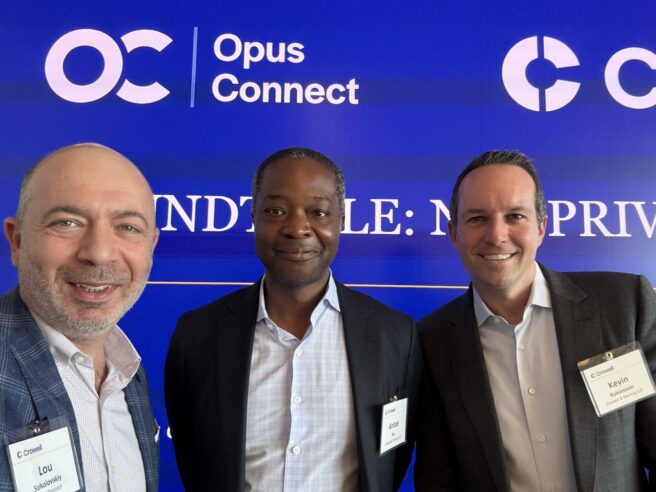
Crowell was pleased to host and sponsor Opus Connect’s recent NYC Private Debt Roundtable. The event drew a group of private debt leaders for engaging and thoughtful discussion around some of the key challenges private debt firms face today, and the emerging opportunities. The conversation covered everything from new technologies shaping the space to how firms are evolving their strategies in response to a changing environment.
Crowell Sponsors ILFA Drinks & Discussion in New York
Crowell was proud to serve as a sponsor of the recent Drinks & Discussion hosted by the International Legal Finance Association (ILFA). The event on April 16 brought together over 150 leading practitioners, funders, and professionals from across the legal finance ecosystem at Grand Brasserie for networking and discussion on one of the most dynamic and rapidly evolving areas of finance.
Crowell has a leading Financial Services group, and is pleased to support the mission of ILFA through our sponsorship.
Continue Reading Crowell Sponsors ILFA Drinks & Discussion in New YorkOFAC Expands Venezuela Sanctions Relief: New General Licenses 56 and 57, and Guidance on Reporting Obligations
On April 14, 2026, the U.S. Department of the Treasury’s Office of Foreign Assets Control (OFAC) issued Venezuela General License 56, “Authorizing Commercial-Related Negotiations of Contingent Contracts with the Government of Venezuela” (GL 56), and Venezuela General License 57, “Authorizing Financial Services Transactions Involving Certain Venezuelan Banks and Government of Venezuela Individuals” (GL 57). OFAC also issued one Venezuela-related Frequently Asked Question (FAQ), FAQ 1248.
These actions represent the latest steps in a continuing U.S. policy of progressively opening channels for commercial and financial engagement with Venezuela, extending the series of general licenses that OFAC has issued since early 2026 across the energy, petrochemical, minerals, and infrastructure sectors.
Continue Reading OFAC Expands Venezuela Sanctions Relief: New General Licenses 56 and 57, and Guidance on Reporting ObligationsOFAC Sanctions Cartel-Linked Casinos and Financial Enablers on the Southern Border
Key Takeaways
- The U.S. Department of the Treasury’s Office of Foreign Assets Control (OFAC) designated six individuals and entities tied to Cartel del Noreste (CDN)—one of Mexico’s most violent drug trafficking organizations—including two CDN-affiliated casinos used for money laundering and drug operations near the U.S.-Mexico border.
- OFAC’s actions are the latest examples of a broader national security strategy to use sanctions, AML authorities, criminal prosecutions, and other tools to counter cartels on the U.S.-Mexico border. These efforts have targeted in particular non-traditional financial institutions such as casinos, public-facing professionals, and disinformation actors.
- The State Department designated CDN as a foreign terrorist organization (FTO) on February 20, 2026, and today’s designations were issued under both Executive Order 14059 (narcotics trafficking) and Executive Order 13224 (terrorism), underscoring the U.S. government’s treatment of major cartels as hybrid criminal-terrorist threats.
Crowell Publishes Article on New York Crypto Bill in Law360
On Jan. 14, New York state Sen. Zellnor Myrie proposed legislation in the New York State Senate that would amend New York law to make it a criminal offense to operate a virtual currency business in the state without the proper license.
By introducing the possibility of criminal penalties, S.B. 8901 — the Cryptocurrency Regulation
CFTC Takes Additional Steps Toward Prediction Market Regulation: What You Need to Know
Overview
On March 12, 2026, the U.S. Commodity Futures Trading Commission (CFTC) took formal steps toward establishing additional regulations for prediction markets. The agency issued an Advanced Notice of Proposed Rulemaking (ANPRM) soliciting public input on potential new rules, and separately, released staff guidance outlining its views on how existing rules apply to prediction market platforms currently in operation. These developments signal a significant shift in the regulatory landscape for an industry that has grown rapidly over the past year.
Continue Reading CFTC Takes Additional Steps Toward Prediction Market Regulation: What You Need to KnowEight Takeaways After Seven Weeks of OFAC’s Six — wait, Seven — New and Updated General Licenses for Venezuela
What You Need To Know
- The U.S. Department of the Treasury’s Office of Foreign Assets Control (OFAC) issued six new general licenses, and updated a seventh that allow for many activities related to: the export of Venezuelan oil and petrochemical products from Venezuela; the exploration, development, and production of oil, gas, and petrochemical products in Venezuela; the generation, transmission, storage, or distribution of electricity in Venezuela; the export to Venezuela of U.S.-origin diluents; negotiating for investment in the oil, gas, petrochemical, and electricity sectors in Venezuela; and the export of Venezuelan gold.
- The new general licenses contain a number of significant conditions, including in GLs 46B and 51, a limitation to the activities of “established U.S. entities,” and in GLs 46B, 47, 48A, 50A, and 51, limits on counterparties and operators, a prohibition on the involvement of entities with specific relationships to China, Cuba, Iran, North Korea, and Russia, or of sanctioned vessels, and contractual requirements to use U.S. law and U.S. dispute resolution mechanisms.
- This regulatory space is fast moving, with multiple changes occurring over a short time period, and any plan to rely on these general licenses and authorizations should include transaction-by-transaction assessment, along with monitoring by compliance and legal functions.
FinCEN Grants Exceptive Relief to Streamline Beneficial Ownership Verification Requirements for Financial Institutions
What You Need to Know
Key Takeaway #1: FinCEN will no longer require covered financial institutions to identify and verify beneficial owners of legal entity customers each time the customer opens a new account at the institution, but rather only in certain circumstances.
Key Takeaway #2: FinCEN will instead require certain financial institutions to identify and verify the identities of such beneficial owners: (1) when a legal entity customer first opens an account with a covered financial institution; (2) when the covered financial institution has knowledge of facts that would reasonably call into question the reliability of beneficial ownership information previously obtained about the legal entity customer; and (3) as needed based on a covered financial institution’s risk-based procedures for conducting ongoing customer due diligence. For (3), covered financial institutions may rely on the customer’s certification that its beneficial ownership information has not changed, unless there is reason to question this.
Key Takeaway #3: The exceptive relief is the latest instance of recent efforts by the Department of the Treasury to modernize and eliminate unnecessary burdens associated with BSA rules; covered financial institutions are likely to welcome the relief.
Continue Reading FinCEN Grants Exceptive Relief to Streamline Beneficial Ownership Verification Requirements for Financial Institutions