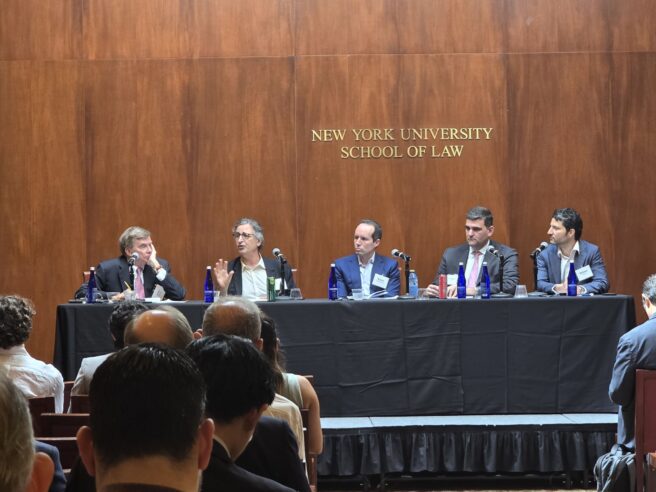
The financing of legal actions by third parties has grown exponentially since the early 2000s and is now common across many common law and civil law jurisdictions. It is still in its infancy in Qatar, but the Qatar International Centre for Conciliation and Arbitration (the “QICCA”) expressly recognised third party dispute funding in its 2024 rules update (the “QICCA Rules”).

This article seeks to provide a brief introduction to third party funding, and how it can make justice more accessible in a time when arbitration has become an expensive endeavour. While third party dispute funding may allow greater access to arbitration, it requires a careful balancing act between the interests of the claim’s stakeholders, and indeed those of the adverse party, with private equity investment demands.Continue Reading Qatar Third-Party Dispute Funding: An Introduction

Seeking to protect their investments in the face of increased liability management exercises, lenders began signing “cooperation agreements,” which required the lenders to cooperate when negotiating to restructure existing debt or provide new debt to their shared borrower. These cooperation agreements protect lenders from “creditor-on-creditor violence” — when one lender (or a subset of lenders) renegotiates with a borrower to the benefit of the negotiating lender and the detriment of the others.

In November 2025, Optimum Communications, Inc. (f/k/a Altice) and CSC Holdings, LLC (together, Optimum) filed a federal antitrust lawsuit against its lenders — Apollo, Ares, GoldenTree, Loomis, Oaktree, and PGIM (collectively, the Cooperative) — challenging their cooperation agreement as an unlawful cartel. In the complaint, Optimum alleges two antitrust theories: (i) the Cooperation Agreement constituted a group boycott of Optimum because the Cooperative members agreed not to individually work with Optimum to restructure debt absent supermajority approval from the Cooperative, and (ii) the Cooperation Agreement constituted an unlawful price-fixing scheme by requiring the Cooperative’s steering committee to negotiate with Optimum exclusively, rather than allow Optimum to negotiate individual discounts with individual lenders. Optimum alleges that because the Cooperative controls approximately 88% of the entire leveraged finance market and 99% of Optimum’s outstanding debt, the Cooperation Agreement has made it incredibly difficult for Optimum to restructure its debt.Continue Reading Optimum’s Shot Across the Bow: An Antitrust Challenge to Cooperation Agreements

Asset-based lending (ABL) and adjacent areas of asset-focused finance continually shift towards the center ground of mainstream corporate finance. Flexibility, underpinned by collateral-driven risk, is in demand. The market continues to diverge (in some instances, becoming even more finely-tuned to complex credit, special situations, and restructuring), but its growth is generally well documented, with regulatory capital treatment and multiple other drivers potentially accelerating the same, particularly outside of the traditional banking sector.

So, what should modern stakeholders look out for? ABL structures typically feature fewer traditional financial covenants than cash-flow lending, but involve real operational visibility, asset monitoring, and dynamic controls. Generally, these activate far more swiftly than a conventional financial covenant breach in a heavier term loan structure.Continue Reading Asset-Based Lending: At Times Covenant-Lite, but Not Control-Lite

In an effort to improve market efficiency and to speed settlement, the Loan Syndications and Trading Association (the “LSTA”) is proposing amendments to its trading documents in order to address concerns that market participants are increasingly failing to make timely payment of the “Purchase Price” with respect to their bank loan trade settlements. Although typically only one or two days late, such failures, on a large scale, can prove to be quite costly to loan sellers and disruptive to the market as a whole. The proposal would introduce language into the LSTA Standard Terms and Conditions for its suite of trade confirmations (the “Standard Terms”) that would require tardy loan buyers to pay a “Late Payment Fee.”Continue Reading LSTA Proposes Introduction of Late Payment Fees in Loan Trade Transactions

According to reports, Saks Global Enterprises, a leader in luxury retail, is preparing to file for Chapter 11 bankruptcy protection imminently. Saks houses such iconic brands as Saks Fifth Avenue, Bergdorf Goodman, and Neiman Marcus. Despite a recent recapitalization, the filing by this iconic company should not be a surprise to those following the industry closely. Retail has continued to face increased costs due to tariffs, inflationary pressures, ballooning consumer debt, and the continued rise of e-commerce competitors (including the upstart Quince). Total debt throughout the Saks enterprise is said to exceed $6 billion. The filing, when it comes, will follow a year-end missed interest payment in respect of certain notes, a sure signal of restructuring activity to come.

For lenders, landlords, suppliers, and other creditors, early preparation for a bankruptcy filing, and taking decisive steps during any bankruptcy case, will be critical to protecting interests and maximizing recoveries.Continue Reading Saks Global Enterprises Bankruptcy: What Creditors Need to Know Now

Paul Haskel was recently quoted in an American Lawyer article that explores trends and new approaches in law firm finance. The article discusses various methods of funding utilized by law firms, including debt finance from traditional financial institutions and, more recently, private capital.

Paul commented, “Currently, most firms who have little cash on hand tend

The use of management service organizations (MSOs) in the law firm space is a new and expanding trend. While uncertainties whether MSOs comply with legal ethical rules remain, with only one decision from the Texas Commission on Professional Ethics touching on the issue so far, continued use of MSOs in law firm transactions is expected.

The UK Ministry of Justice has announced an intention to remove English third-party litigation funding from the current requirements of the Damages-Based Agreements Regulations 2013 (“DBA Regulations”) and provide for a different regulatory framework. As we have discussed previously here and here, various forms of uncertainty remain for third parties who wish to fund

On November 13, 2025, the U.S. Department of the Treasury’s (“Treasury’s”) Financial Crimes Enforcement Network (“FinCEN”) issued a finding (“Finding”) and related notice of proposed rulemaking (“Proposed Rule”) pursuant to Section 311 of the USA PATRIOT Act (“Section 311”), targeting ten Mexico-based gambling establishments (“Gambling Establishments”).  FinCEN found transactions involving the Gambling Establishments to constitute a “class of transactions” of “primary money-laundering concern” for purposes of Section 311.  In particular, FinCEN found that the Gambling Establishments ultimately were controlled by a criminal group that used the establishments to facilitate money laundering for the Sinaloa Cartel.

Continue Reading Treasury Continues Focus on Cartels: Understanding FinCEN’s Latest Action Restricting Transactions with Certain Mexico-Based Gambling Establishments

In response to the increased frequency of majority-backed debt restructuring transactions that have significantly disadvantaged minority debtholders, lenders in the syndicated loan market have increasingly turned to cooperation agreements among themselves as a means to mitigate the risk of exclusion from such deals. While often effective, this approach has been met with hostility from the